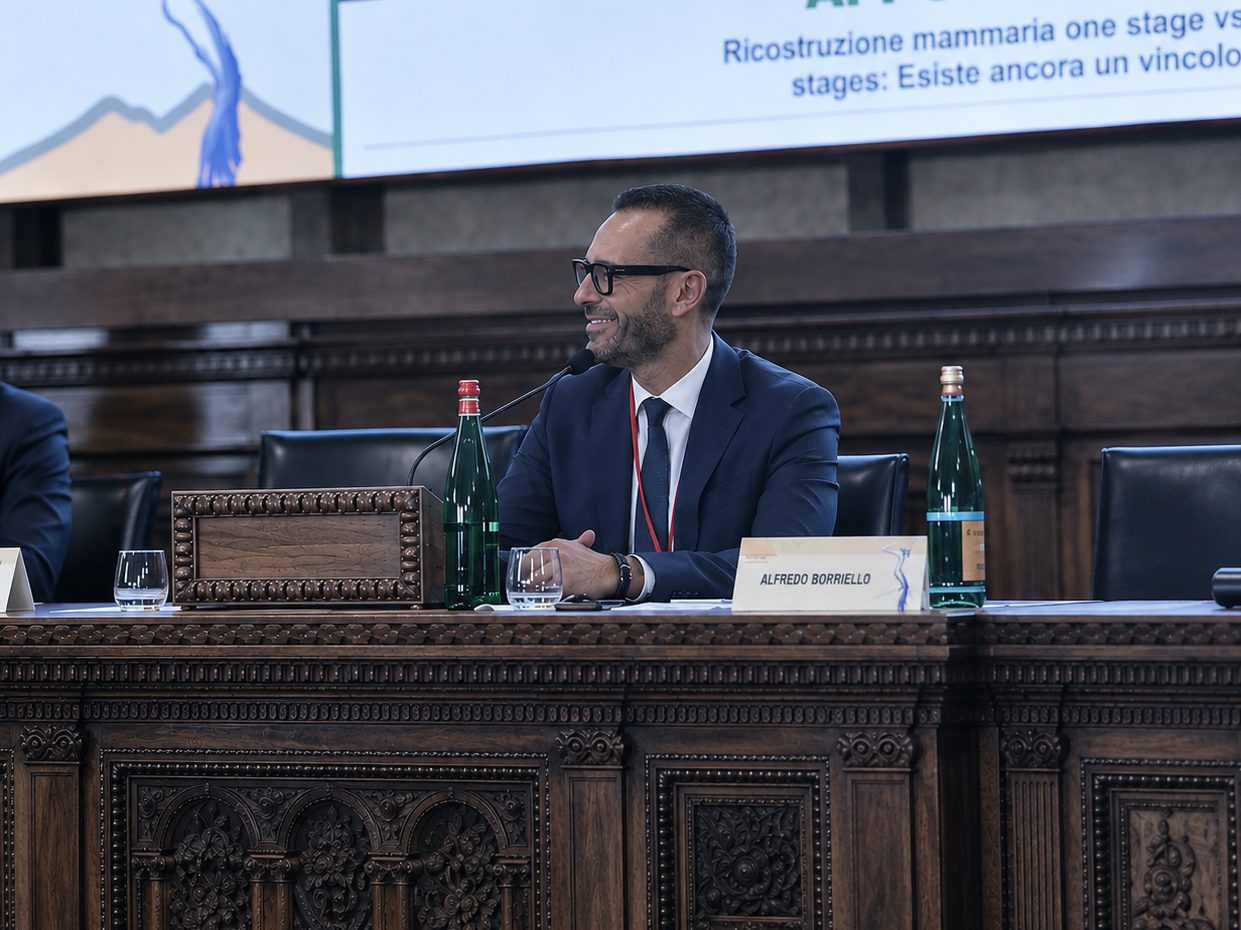
The second edition, at the Federico II Congress Centre
On 27 and 28 October 2026 the Federico II Congress Centre in Via Partenope, Naples, hosted the second edition of the congress "Oncological and Reconstructive Breast Surgery. Focus on: difficult diagnoses and treatments". It was promoted and chaired by Prof. Alfredo Borriello, plastic surgeon, and Dr. Antonio Marano, breast surgeon, who head Plastic Surgery and Breast Surgery respectively at Ospedale del Mare.
The aim of the two days was to review the latest knowledge in the treatment of breast cancer, bringing together every specialist who follows the patient: breast radiologists, pathologists, breast and plastic surgeons, oncologists, radiation oncologists and psychologists. Alongside surgeons from Federico II and the University of Campania "Luigi Vanvitelli", experts from the universities of Rome, Bari and other institutions took part, with room for psycho-oncology and for patient associations, including Komen Italia.
The topics of the two days
The sessions between specialists focused on the cases where diagnosis and treatment call for the most experience:
Prof. Borriello in Il Roma
On 27 October, the opening day, Il Roma published an interview by Laura Caico with Prof. Borriello, who previewed the key topics of the two days. Here are the main passages, translated from Italian.
A congress that brings together the breast specialists and reconstructive plastic surgeons of Campania, and beyond?
"Yes. Besides the surgeons of Federico II and of the University of Campania 'Luigi Vanvitelli', our panels will include leading national experts from all over Italy, from the universities of Rome, Bari and elsewhere: a line-up of the highest profile and prestige."
What are the main points that will be discussed?
"We will look in depth at reconstructive techniques […]; above all, we will focus on choosing the most suitable type of reconstruction according to the patient's condition, her clinical situation and the characteristics of her tissues. Then we will examine how to treat cases that have undergone radiotherapy, because they can present various difficulties."
What difficulties does radiotherapy bring?
"Although it is necessary and strongly recommended in some cases (roughly 30% of mastectomies with immediate reconstruction), radiotherapy, which destroys cancer cells and limits the chance of the tumour returning […], causes moderate complications (at different rates depending on whether implants, flaps or expanders are used) that affect the aesthetic result but can be resolved with supportive care."
What other aspects will be examined?
"[…] Dr. Marano will illustrate the methods he and his team use to preserve the nipple-areola complex as far as possible, limiting skin removal and making breast reconstruction easier. The reconstruction then relies on latest-generation implants, on lipofilling, which restores volume, and on biological meshes, which provide further support for an ever more effective reconstruction, so that both breasts look the same after the reconstructive operation."
A tailored reconstruction for each patient
The common thread of the congress was tailored breast reconstruction: there is no single technique that suits everyone, but a strategy built around each patient. These are the factors that guide the choice.
The patient and her tissues
The starting point is the clinical situation, body build and tissue quality: they indicate whether to reconstruct with implants, with the patient's own tissue or by combining the two.
Nipple and areola
When oncology allows it, mastectomies that preserve the nipple and areola and limit skin removal make reconstruction easier and the result more natural.
Implants and biological meshes
Latest-generation implants, together with biological meshes that give the tissues extra support, allow increasingly reliable reconstructions.
Lipofilling
Lipofilling, the grafting of the patient's own fat, restores volume and refines contours, to make the two breasts as similar as possible.
When reconstruction meets radiotherapy
Radiotherapy is an important part of treatment: it destroys tumour cells and reduces the risk of the disease returning. As Prof. Borriello pointed out, it concerns roughly 30% of mastectomies with immediate reconstruction.
On irradiated tissue reconstruction is more demanding: complications are usually moderate, at different rates depending on whether implants, flaps or expanders are used, and can affect the aesthetic result. They are, however, treatable with supportive care: this is why the reconstructive strategy is planned from the outset with the expected treatments in mind.
Breast reconstruction: the most common questions
What is "tailored" breast reconstruction?
It is an approach in which the technique is not decided in advance but chosen for each patient. Clinical situation, tissue characteristics, planned treatments (such as radiotherapy) and expectations are assessed, and on that basis the choice is made between implants, expanders, the patient's own tissue or a combination, with the aim of two breasts as similar as possible.
Can the breast be reconstructed after radiotherapy?
Yes. Radiotherapy makes tissues less elastic and reconstruction more demanding, with a higher risk of complications that can affect the aesthetic result. These are usually moderate complications, treatable with supportive care; this is why the reconstructive path is planned knowing the treatment schedule in advance.
What is lipofilling used for in breast reconstruction?
Lipofilling involves harvesting a small amount of the patient's fat, purifying it and grafting it into the reconstructed breast. It restores volume, softens contours and improves symmetry, and often completes an implant-based reconstruction.
Can the nipple and areola be preserved during mastectomy?
In selected cases, yes: when the location and characteristics of the tumour allow it, the breast surgeon can perform a mastectomy that preserves the nipple and areola and limits skin removal. It is an oncological decision, made case by case; when possible, it makes reconstruction easier and the result more natural.
How do I book a breast reconstruction consultation?
You can book a consultation with Prof. Borriello at his practice in Naples, in the Chiaia/Mergellina area, using the form on this page, by phone or on WhatsApp. Bring your tests and the reports of any previous surgery: they help assess the reconstructive options in your case straight away.
Book a consultation at the Naples practice
Prof. Borriello sees patients at his private practice in Naples, in the Chiaia/Mergellina area. At the first visit he reviews your medical history and your tissues and explains which reconstructive options are possible, with timing and expected result.
Request a consultation
Sources
- Il Mattino, "Torna a Napoli il convegno 'Senologia oncologica e ricostruttiva' il 27 e 28 ottobre al Centro Congressi Federico II", 26 October 2026
- Il Roma, "Senologia oncologica e ricostruttiva, esperti a confronto", by Laura Caico, 27 October 2026
This content is intended for informational and educational purposes only. It does not in any way replace professional medical advice, diagnosis, or treatment. For any medical questions or concerns, it is essential to consult your physician or a qualified specialist.